
In Hong Kong the award normally goes to the lowest conforming offer, so most of the work in a tender evaluation is conformity, not scoring. That is also the half an AI can do: read every submission against a numbered checklist, cite the clause and the page, and put six price schedules on one basis. The score stays with the panel, and so does every decision to reject a bid.
On this page
AI is usually sold into this market as a scorer. A model that ranks bids by technical merit answers a question most procurement teams never ask; where a marking scheme does exist, it is the exception and it is used mainly on works contracts. The question they do ask is a conformity check that runs to hundreds of line-by-line comparisons, done by one or two people at the end of a long day, against submissions written in six different formats.
Six bidders, a price schedule of forty items and three pages of mandatory conditions is an ordinary mid-sized tender. It is also several hundred checks, any one of which can end the bid.

Most of an AI bid evaluation is spent on one word: conforming
A mandatory condition is rarely written once. It appears in the instructions to tenderers, again in the specification, again in the form of tender, and once more in whatever addendum went out in the final week. A bidder who misses one does not become a weaker bidder. Under the Stores and Procurement Regulations, a tender that leaves out an essential requirement is non-conforming on the face of the rules, and the department may not go back to the tenderer for the missing document. Nor is rejection the panel’s call: no department may reject a tender without the approval of the relevant tender board, and certainly not on the software’s say-so.
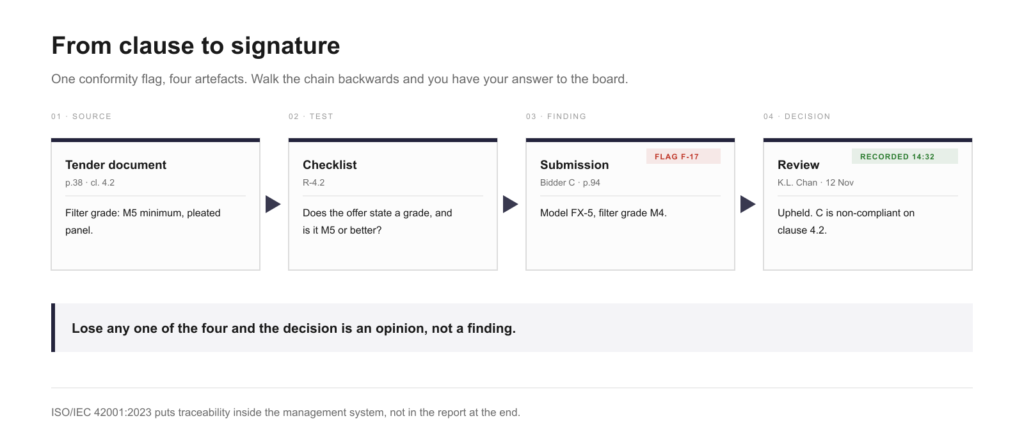
That allocation of authority matters more than it looks in an AI bid evaluation. Because a rejection is a board decision, every rejection has to survive one question: which clause, which page, which submission. “Did not comply with the technical requirements” is not an answer. The officer needs the clause number, the page, and the wording that failed.
Reading for that evidence is mechanical work with an expensive error rate. It is also the one job where a machine’s most obvious weakness — it does not get tired at nine in the evening on the last day — is worth more than its intelligence.
The work stays invisible because it produces nothing visible. A conformity check that goes well leaves a clean report and no memory of the afternoon it consumed. That is why it attracts the junior officer at the end of the day, and why the failure it prevents is only noticed as it happens.
The Regulations are explicit about departures. Where a subsidiary tender board awards a contract to something other than the lowest conforming offer — or, where a marking scheme is used, to something other than the highest overall scorer — the details and the reasons go to the Central Tender Board at the end of that month. A departure is not forbidden. It is documented, which means the reasoning has to exist in writing before the award, not after.
Where AI helps, and where it must not go
This is the split we use when a procurement team asks where to put the tool in an AI bid evaluation. Read the last column before the third one.
| Stage | What the panel still has to decide | What AI does well | What must not be handed over |
|---|---|---|---|
| Conformity | Whether a deviation is material | Reads every submission against a numbered checklist and cites the clause and the page | Declaring a bid non-conforming |
| Eligibility | Whether a reference is genuinely comparable | Extracts dates, values and completion evidence from certificates | Accepting a reference that does not exist |
| Price alignment | Which basis the comparison should use | Normalises duty, currency, unit, delivery terms and years of spares | Choosing the evaluation basis |
| Technical scoring | The mark itself, and the reason for it | Totals the sheet, checks the arithmetic, flags missing evidence | Writing the justification for a mark |
| Clarification | Whether an answer changes the bid | Drafts the question from the gap it found, and logs the exchange | Judging what the answer means |
| Award | The recommendation, and the ability to defend it | Assembles the trail: flag, decision, reviewer, timestamp | Making the recommendation |
Every row where the tool is allowed to decide is a row where somebody will eventually have to defend a decision they did not make. That is not a technology risk. It is a governance one, and it is the reason the third column is shorter than it could be.
Three moves that make the difference
Turn the tender document into numbered tests
Nothing in an AI bid evaluation can be checked until the conditions become a list: one line per requirement, a clause reference, and a test that answers yes or no. Most organisations discover at this step that they have been running three slightly different checklists for the same kind of tender, and that the newest one is not the one in use. Consolidating them is worth more than the software.
Align the schedules before comparing money
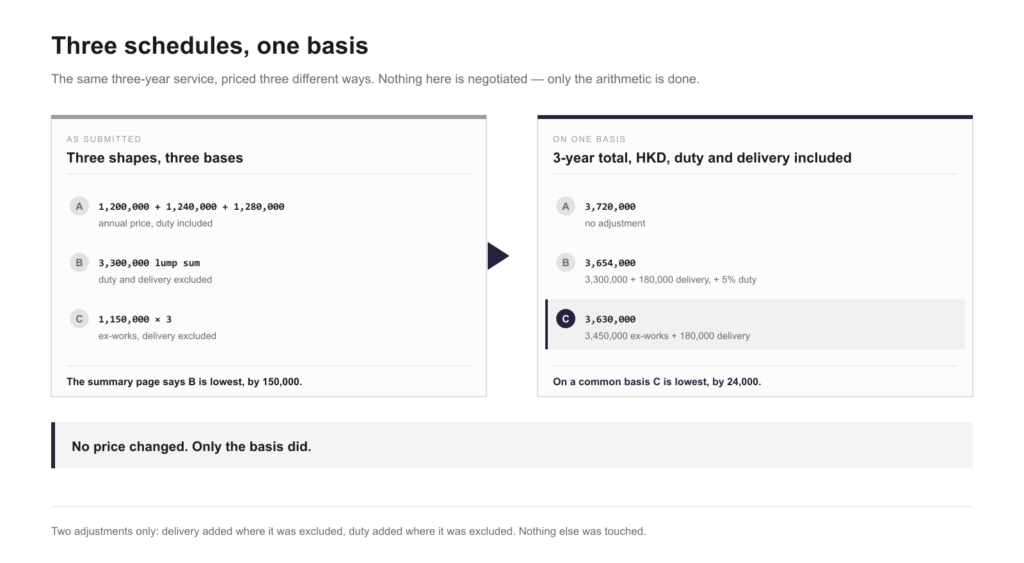
Two bids can look a third apart on the summary page and land within a few percent of each other once the basis matches. The usual culprits are duty, currency, unit of measure, delivery terms, the number of years of spares included, and whether the optional items were priced at all. Normalising these is arithmetic, and arithmetic at the end of a long day is exactly what a person should not be doing.
A three-year service priced annually by one bidder and as a lump sum by another is the standard example. So is a schedule that quotes ex-works against one that quotes delivered and installed. Neither is a trick; both are normal commercial practice, and both make the summary page lie.
Every flag has to point at a page
A finding is only usable if it carries its evidence. Shown requirement 4.2 not met, a reviewer will check it, argue with it, or ignore it. Shown the clause and the page, the same reviewer decides in ten seconds, and that is most of the throughput an AI bid evaluation actually buys. The citation is also what makes an override auditable, which is the real reason to insist on it.

Write the rule into the process before the tool arrives: no flag without a citation, no override without a name.
The clarification round is where the record breaks
Clarification is the part of an AI bid evaluation that looks like correspondence and behaves like evidence. A bidder is asked to explain a price, or to confirm a delivery date, and the answer arrives by email three days later. Whether that answer changes the bid is a judgement the panel has to make, and the reason it matters is that a clarification which changes the substance of a bid is no longer a clarification.
Two things go wrong here with or without AI. The question is worded so broadly that the answer rewrites the offer, and nobody notices until an unsuccessful bidder asks. Or the exchange lives in one officer’s mailbox and never reaches the evaluation report. The fix is dull: every question generated from a specific gap, every answer attached to the flag that produced it, every round numbered. Supplier portal adoption usually stalls at exactly this point, for the same reason — the portal records the submission and forgets the conversation.
Numbering the rounds costs nothing and settles most later disputes about what was asked. It also prevents the quieter failure: five bidders asked five slightly different questions, and the answers then compared as though they had been given to the same question.
Four ways this goes wrong
None of these is a model problem. All four are process problems, and none of them will show up in an AI bid evaluation demonstration.
| Failure | What it looks like on the day | What it costs |
|---|---|---|
| Consistency mistaken for correctness | The same three bidders are flagged every round, so the flags stop being read | A real deviation is waved through |
| A verdict instead of a citation | One line saying non-compliant, with no clause and no page | The panel redoes the check by hand |
| The tool decides rejection | A bid is set aside before the board ever sees it | A challenge you cannot answer |
| Overrides with no record | Flags quietly cleared so the report can go out | No evidence that anyone exercised judgement |
The fourth failure is the one that ends up in front of a board. Where a recommendation departs from the lowest conforming offer, the board has to be shown why, and the record has to survive being read a year later by someone not in the room. If the tool’s output is a verdict with no trail behind it, the panel rebuilds that trail from memory three weeks later, and memory is not a record.

There is a second-order version of the same problem that is worth naming, because it is where most pilots die: the tool is tested on clean PDFs supplied by the vendor, then meets a real submission scanned at an angle with a handwritten correction on page 94. Bid rigging detection runs into the same wall — the analysis is only as good as what survives the scanner.
Where eTender sits in an AI bid evaluation
The evaluation module does the two unglamorous jobs of an AI bid evaluation. It reads the tender document into a requirement list, checks each submission against it, and returns a flag that carries the clause and the page rather than a verdict. Separately, it pulls the price schedules into a single grid, so the comparison is made on one basis instead of six.
The scoring stays with the panel, which is where the regulations put it and where any honest AI bid evaluation leaves it. What the system keeps is the part that turns an evaluation into an audit trail: who accepted a flag, who overrode it, when, and on what evidence. Our tender management module carries the same record through the rest of the cycle, so the tender file and the evaluation file are one file — and on an equipment contract, the spares and warranty terms priced at evaluation become asset records the day the contract is signed.
The test to run before you buy anything
The only AI bid evaluation benchmark worth having is your own last tender. Take it, print the mandatory conditions from the tender document, then time one officer checking a single submission against them, writing down the clause and the page for every finding. Multiply by the number of submissions you received.
If the answer is under an hour, you do not need this yet. If it is a day, you already know what an AI bid evaluation is for. You also know it is not the score. Choosing an e-tendering platform usually starts with the scoring module, because it is the part that demos well.
Ask every vendor the same question: show me a submission the tool got wrong last month, and show me who overrode it. A demo that cannot answer that is a demo of a scoring engine, and a scoring engine is the thing this article just spent fifteen hundred words telling you not to buy first.
References
- Financial Services and the Treasury Bureau (HKSAR) — Tender Procedures for Government Procurement — Chapter III of the Stores and Procurement Regulations
- ISO — ISO/IEC 42001:2023 Information technology — Artificial intelligence — Management system
- Financial Services and the Treasury Bureau (HKSAR) — A Guide to Government Procurement